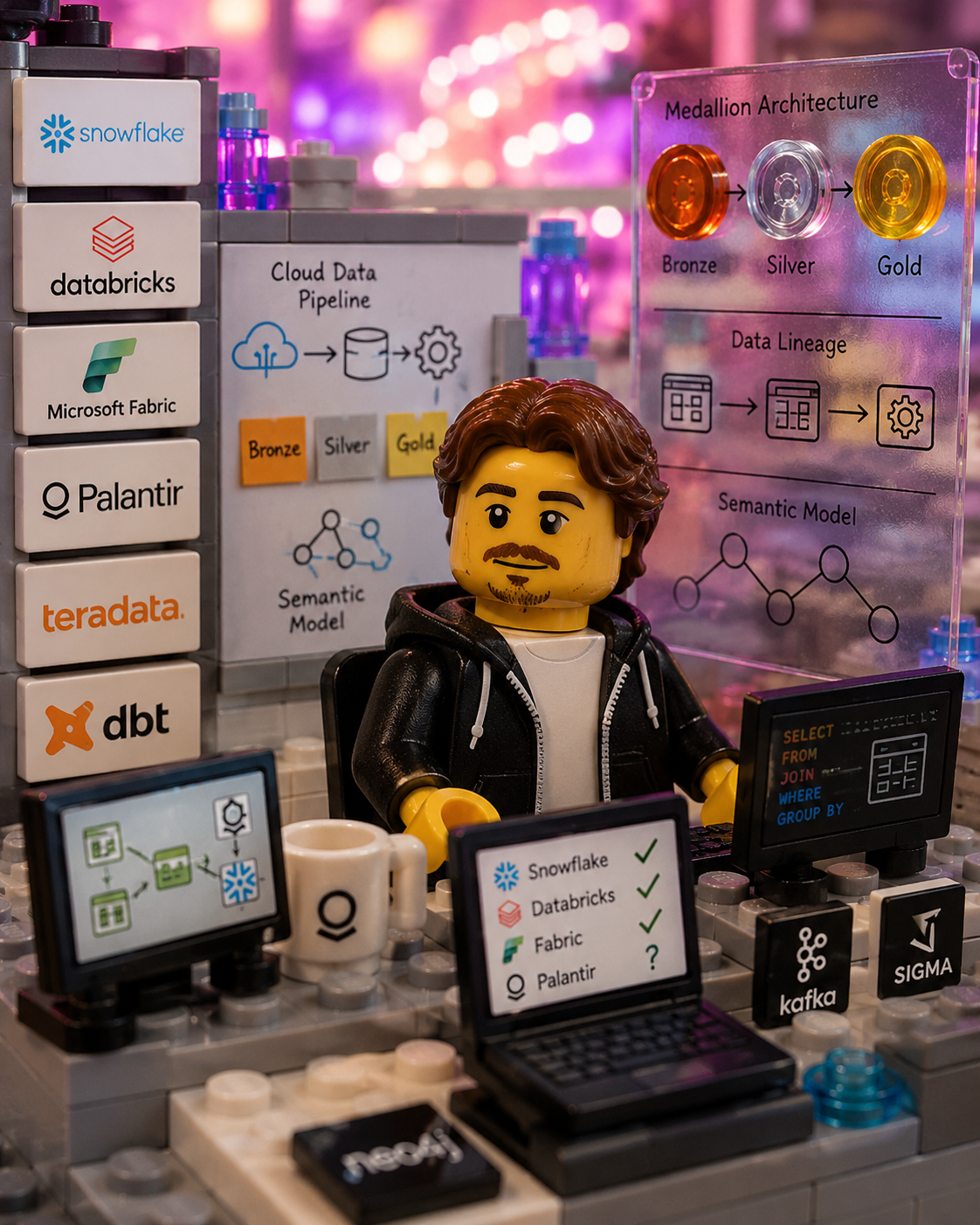
LEGO portrait of Don in his data architecture studio

Howdy,
I'm Don.

Legally one syllable.
solutions architect · data engineer · musician · photographer · runner · husband & dad · lifelong student of everything
The philosophy

Stay curious. Build things. Share what you learn.

Stay curious.
Build things.
Share what you learn.
Help others when you can.
Leave things better.

Whether you're here for data, music, photography, writing, or just poking around, you're among friends. Life's a little strange, people are wonderfully complicated, and none of us gets a complete map. We explore anyway. If something here makes you think, laugh, wonder, or see the world a little differently, then I'm glad you stopped by.

My whole life I've liked too many things. I eventually figured out the categories everyone kept sorting things into had way more in common than people let on — and that noticing that was the actual skill.

I think in graphs. Ideas, systems, art, risk, data — they all carry tags in my head and the connections are kind of the whole point. I live with AuDHD, and the ADHD helpfully loosens the rigidity of the ASD just enough for things to move around.

At four I asked why I was here and got a brutal answer. That pushed me toward absurdism early — if life is just a process, then everything and everyone is somewhere in the middle of one. That became the foundation: seek truth, understand the system, use what you've got to help people.

A high school teacher drilled "consider all the possibilities" into me and it never left. Neither did da Vinci, Disney Imagineering, Sonic, or the general idea that physics is just having fun. Why can't data be fun? Why does serious work have to be humorless?

Track and martial arts shaped that mindset. My black belt took six years instead of four because coordination didn't come naturally. I eventually hit 10.5 in the 100m and sub-4:20 in the mile — then my kneecaps gave out in 2015. After a COVID hospitalization I turned AI and analytics on myself as a recovery tool. Ten years later I'm sub-6:30 again, which I'll take.

I did filmmaking for a while — mostly comedy — and apparently wasn't that funny, because I ended up in tech to pay rent. But a good joke reveals a different process, a system underneath the obvious one. That's why Chaplin, Monty Python, Douglas Adams, Adventure Time, and Kung Fu Panda all live on the same map for me. They're almost always about someone misunderstood discovering that life doesn't need a forced happy ending to still mean something.

Communication was always the hard part — delayed speech, a tongue tie, delayed emotional processing. I spent years expressing myself visually before words came naturally. AI didn't create the flood of ideas, it gave them a channel. I use it for wellness, clarity, and expression. Not as a shortcut. As infrastructure.

People have told me "we're not artists, we're engineers" like those are opposites. Anything taken seriously enough becomes an art — mastery is just learning when you're allowed to break the rules. I learned that through filmmaking first, then applied it to systems, analytics, and architecture. Socrates said wisdom starts with knowing you know nothing. Jake the Dog said "sucking at something is how you kind of get good at something." Both are correct.

So I don't hoard knowledge. I share it, try to make the people around me better, and keep building things. This site is a window into all of it.
Self-taught resume, made visual

Innovation Through Inspiration

Open LinkedIn →
100% self-taught

I learned by taking the problems nobody wanted to sit with long enough to solve.

The timeline below isn't a scorecard. It's a map of high-risk projects where people said the answer wasn't possible — and where sitting with the problem long enough actually changed the outcome. Inspired by da Vinci, Disney Imagineering, comedy, and the general belief that physics is just having fun, I treat learning as interconnected. What I pick up in one world gets applied everywhere else.

How I approach it
Observe, validate, then design. Consider all the possibilities, challenge the first answer, and keep asking: what if the obstacle is the way, or what if I'm the problem? Refine the system before asking a team to execute. AI is a clarity and expression layer, not a shortcut around thinking.
The pattern
Abstraction, reduction, process thinking — then long-term systems instead of band-aids. When the premise is wrong, call it out and solve the actual problem instead of burning people out on the wrong one. The more the work helps others, the more it matters.
2013-2015
CMG Financial

Loan processing bottleneck

Solved: traced how data quality defects cascaded into later mortgage stages and slowed the full operating cycle.
Outcome: helped move processing from roughly 40-60 days to about 10 days, increasing business volume.
2017
HP (KPMG)

Geospatial workforce intelligence

Solved: used sine and cosine dynamically to calculate location distance and understand impacted departments, replacement difficulty, and what people actually did.
Outcome: geospatial visualizations saved HP several million by turning location and workforce risk into decision infrastructure.
2017-2018
KPMG SPI

Standardized insight engine

Solved: abstracted standardized data visualizations for buy-side and sell-side clients, then reworked New, Lost, Existing scenarios for any dimension using binary strings and temp tables.
Outcome: created fast on-the-spot insights, removed up to 15% algorithmic error, reached 100% accuracy, and helped retain over 60% marketshare.
2018
Barnes & Noble (KPMG)

SQL that beat Hadoop

Solved: built dynamic partitioning approaches for massive SQL workloads.
Outcome: let SQL instances outperform Hadoop clusters on larger engagements, including work used to help save Barnes & Noble.
2018-2019
PG&E (KPMG)

Infrastructure failure geospatial analytics

Solved: hacked Tableau into infrastructure drilldowns across cost of failure, probability of failure, and disaster-impacted cities by population.
Outcome: helped the client build a renovation plan for California infrastructure so PG&E could stay in business.
2019-2020
ReliaQuest

Grey Matter cyber threat product

Solved: built a threat intelligence data platform with 40+ production pipelines and used graph association and commonality analysis to accelerate the on-prem to AWS migration.
Outcome: bought the team about three months and became part of the proprietary Grey Matter Platform, validating real cyber threats and reducing alert fatigue at tens-of-millions stakes.
2020
Mpirik

Artificial valve outcomes dataset

Solved: transformed semistructured S3 data into a design fit for linear analyses of artificial heart valve longevity and quality.
Outcome: created a high-value patient outcomes dataset showing how artificial valves performed across demographics and changed people's lives.
2021
MUFG (KPMG Lighthouse)

Presto SQL Workiva rescue

Solved: when Workiva had too many sheets to pipe large datasets, used positional indexing and masked data so Presto SQL could dynamically route it correctly.
Outcome: saved the MUFG engagement, protecting a roughly $15M program.
2021-2024
Launch

N-to-N pipeline factory

Solved: built a dynamic parallelized ADF framework that could pipe any source to any sink across hundreds of tables.
Outcome: accelerated Snowflake platform delivery years before that source-to-sink factory pattern was common.
2024-2025
First Command

Fabric initiative and data product design

Solved: used graph thinking to kick off the Fabric initiative and design data products while pushing for stronger architectural direction.
Outcome: shifted the work toward productized data foundations and clearer leadership expectations, even when that meant challenging decisions that were hurting teams.
2025-2026
InformData

Graph identity validation

Solved: built Snowflake graph identity validation with recursive SQL and multiple similarity algorithms including Levenshtein, Jaro-Winkler, and Soundex.
Outcome: unlocked about a $34M people data product while continuing the leadership work of uplifting others, bringing out their best, and enabling the team.
2026
Anblicks

Snowflake Cortex accelerators

Solved: created a suite of AI accelerators for survey, quality, masking, tagging, dictionary, and maintenance workflows.
Outcome: part of a 10+ accelerator portfolio, packaged as firm IP with about $875K ROI on a single engagement while sharing knowledge to make the firm better suited to help others.
Connect

Find me across the spectrum

Music, photography, data, writing — it's all here. And if you want the professional side, LinkedIn has that too.

Out in the world